Festive season marketing in India: a five-month campaign calendar, Diwali to Republic Day
Most festive season marketing plans in India still fit on one page: a Diwali creative, a discount and a budget that runs out around Lakshmi Puja.
The buying no longer works that way. Meta's Festive Accelerator 2026 playbook describes a festive season of about five months, from the weeks before Diwali to the Republic Day sales at the end of January. Google's festive guide for 2026 says search interest for "Diwali sales" started rising as early as August.
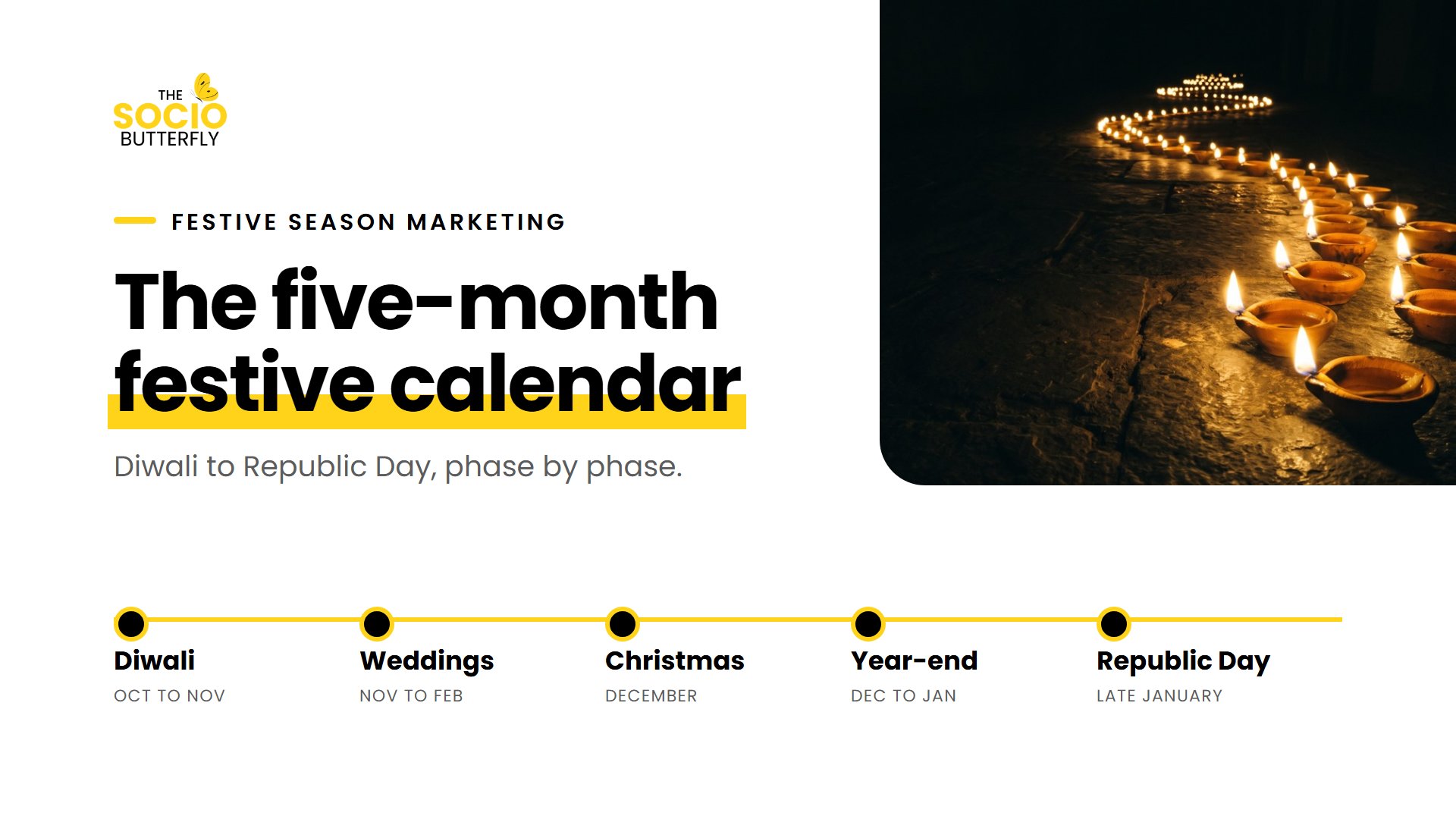
This is a practical calendar for founders: what your buyers are doing in each phase, what to run, and one thing to get right. Diwali 2026 is on 8 November. The calendar works the same way every year.
Why the festive season now runs five months
Three things have stretched the season.
Buyers research longer. Google's research with Ipsos found that 9 in 10 festive buyers researched before buying, with an average of 8.3 searches and 7.7 videos per shopping journey.
There are more buying moments. After Diwali come Black Friday and Cyber Monday for online stores, the November to February wedding season, Christmas and year-end, and the Republic Day sales.
Buyers are spread wider. Redseer estimates that in the first two days of this year's festive sales, around two-thirds of online shoppers came from Tier 2 cities and rural areas. Meta says 60% of new online shoppers now come from Tier 2 and Tier 3 markets.
So a plan that peaks and stops at Diwali leaves most of the season to someone else.
The festive season marketing calendar, phase by phase
Phase 1: Before the peak (about six weeks before Diwali)
What buyers do: browse, save, compare, ask friends, watch videos. Meta says 86% of shoppers look for inspiration on social media before they buy.
What to run: content that helps people choose. Short videos of the product in real use, creator content, how-to and gifting ideas.
Get this right: build your warm audience now. Everyone who watches, visits or messages you is someone you can talk to again at the peak and after it.
Phase 2: Diwali week and the last 48 hours
What buyers do: decide fast. Google and Ipsos found that 70% of festive shoppers made a spontaneous purchase.
What to run: reminders to the people who already know you, a clear offer and a simple way to buy or ask.
Get this right: reply to every enquiry the same day. Diwali week is when enquiries peak and teams go on leave. An instant WhatsApp reply and a named person on duty protect the money you already spent on ads.
Phase 3: After Diwali to the end of November
What buyers do: the gifting rush ends, but buying does not. Online shoppers wait for Black Friday and Cyber Monday. Families start wedding shopping.
What to run: a thank-you to your Diwali buyers, and retargeting of the people who watched, visited or enquired but did not buy.
Get this right: do not switch everything off on 9 November. The audience you built is still warm.
Phase 4: The wedding season (November to February)
What buyers do: spend on gifts, clothes, jewellery, home, catering, venues, photography and travel.
What to run: wedding-specific creatives and offers, even if you are not a "wedding brand". Gift boxes, bulk orders, home refresh, family travel.
Get this right: if your business touches a wedding in any way, treat this as a second festive peak with its own plan and budget.
Phase 5: Christmas and year-end (December)
What buyers do: personal and corporate gifting, holiday travel, dining out. In B2B, teams use up year-end budgets and plan the new year.
What to run: gifting and corporate gifting for B2C, and planning or audit offers for B2B buyers who are setting next year's budget.
Get this right: corporate gifting orders are often placed well before the festivals. Reach the decision maker before the order goes out.
Phase 6: New Year, Sankranti and the Republic Day sales (January)
What buyers do: new-year plans for health, learning and money. Sankranti in mid-January in many states. The Republic Day sale window at the end of the month.
What to run: fresh-start offers, and one last festive push to everyone who engaged since October.
Get this right: close the season with a review. Count sales and cost per sale, not reach and likes.
Three rules for the whole season
1. One idea, many versions. Meta's advice in its 2026 playbook is to build a system of creative, not a single festive ad. Keep one strong idea and make it into a reel, a static post, a carousel, a WhatsApp message and a local-language version. Change the hook every week.
2. Carry your audience forward. Every phase should start with the people the last phase brought you: viewers, visitors, enquiries, buyers. Retargeting, WhatsApp and reminder ads cost far less than finding new people every time.
3. Be different, not just louder. When every festive ad shows the same diya and the same discount, buyers compare on price alone. A product shown inside a real moment, or a gift that is hard to compare, does more than a bigger percentage. Meta reports that content showing a product transforming a moment earns 2.3 times the save rate.
Quick checklist before each phase
- Who are we talking to: new people, or the people the last phase brought us?
- What is the one idea, and how many versions of it do we have?
- Is our offer something other than a price cut?
- Who replies to enquiries this week, and how fast?
- How will we count the result in sales?
Frequently asked questions
When does the festive season start for marketing in India?
Earlier than most plans assume. Google says search interest for "Diwali sales" starts rising in August, and Meta describes a Diwali peak that begins about six weeks before the festival.
How long does the festive season last?
About five months, according to Meta's Festive Accelerator 2026 playbook: from the weeks before Diwali to the Republic Day sales in late January, including the November to February wedding season, Christmas and year-end.
Should a small business keep running ads after Diwali?
Usually yes, with a smaller budget aimed at people who already know you: viewers, website visitors, enquiries and past buyers. They are the cheapest people to reach and the most likely to buy.
If not a discount, what should a festive offer be?
Something worth more to the customer than it costs you, and hard to compare with a competitor's percentage: a personalised gift box, free installation, a styling session, an extra year of service.
Want the deeper version?
We have written a short special report, "Same Diya. Same 10% Off. Same Ad.", on why most festive ads look alike, what that does to your margin, and a five-minute test for your next festive post. Message "DIYA" on WhatsApp to +91 94218 36060 and we will send you the PDF.
Or book a free 20-minute call with Kedar Pradhan, our co-founder, and bring your festive plan. You will leave with an honest view of what to keep, what to cut and one idea for the rest of the season.
Sources
- Meta Festive Accelerator 2026: CMO Playbook, reported by Adgully, 15 October 2026
- Think with Google: festive advertising in AI search, India, September 2026
- Redseer Strategy Consultants festive sales estimate, reported by Outlook Money, 12 October 2026
About the author
Kedar PradhanI built The Socio Butterfly after seeing good brands treated like monthly invoices, and worse, handed off to interns with little real expertise. I work as a true growth partner. Strategy, execution and accountability stay with me. Coming from a sales background, I believe marketing is measured by one thing: sales. Growth isn't activity. It's results.